Author: Supriti Vaidya

  • An Ingenious Invention – the Rice Paddy

    Today I’m going to explore the world of rice paddies, which are areas of land flooded with water, in which rice can be grown.  Paddies can be created on flat land and valleys, known as lowland paddies, or carved into gentle hillsides, called terraced paddies. 

    To make a terraced paddy, you basically create a flat patch on a hillside, and put a small ridge around it, so that it holds just the right amount of water, and any excess can flow down to the next terrace.  What a clever idea!  If they’d invented it today, the inventor could patent it and make a fortune. 

    But you know, rice paddies didn’t spring into existence fully formed. They evolved over thousands of years, starting with farmers who simply built mud walls around existing swamps around 5000 BCE, and culminating in those dramatic terraced structures carved into hillsides during the Tang dynasty.  The evolution was born out of necessity, not some burning desire to carve terraces into hillsides.  As populations grew, farmers started running out of conveniently located natural swampland, and they started moving inland and making changes to what they did over time.

    My first encounter with a rice paddy was, strangely, while we were on holiday in Spain.  We were taking a little boat trip on a river to get away from the heat, and the boat took us near some rice paddies.  It was a surprisingly peaceful experience.

    The cleverness of rice paddies lies not just in that they can be carved out of hillsides.  They’re a fabulous way of weed control too.  Rice loves growing in water, and doesn’t drown easily.  So although it doesn’t technically need a huge depth of water, if you keep a certain depth, it will be too much for most weeds to survive, but the rice is happy.  I reckon in other types of farming, you have to constantly battle with the weeds trying to outdo whatever crop you might be trying to grow.
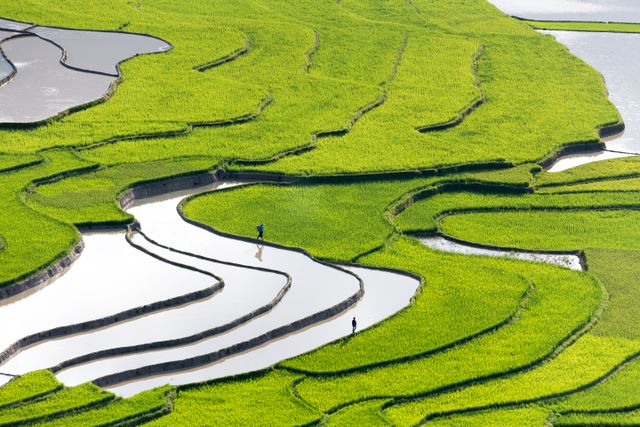
    A hillside rice paddy – doesn’t it look stunning!

    So back to the boat trip.  It was down a small river, which means that rice paddies don’t have to be created in stagnant water.  In fact, stagnant water rice paddies are anaerobic, and can eventually start trapping toxic gases, whereas the flowing water of a river constantly replenishes dissolved oxygen levels around the rice roots, which helps their growth.  Obviously you can’t plant rice in a deep, fast-moving river – I doubt the Amazon would be a good candidate for growing rice.  But thinking about it, its delta, where it meets the sea may not be a bad spot. Let me check.

    Well there you go!  Apparently the Amazon delta has been used for rice farming for several thousands of years.  It even has a name – estuary farming. Estuary farming in the Amazon isn’t exactly fizzling out, but it is becoming less lucrative than other forms of rice farming.  So smallholders are combining estuary rice farming with prawn/fish farming in an effort to raise profits. What a good idea! Imagine being able to source an entire meal from a smallholding in the Amazon estuary!

    The next time I saw a rice paddy was when I was on a train in Indonesia.  The rice paddies were on a hillside, and what a beautiful sight they were.  That lovely, lush green which I’ve only ever seen in photographs was a reality.  And people wearing those pointed cane hats, like the one shown below; I absolutely love those hats.  In fact, so enamoured was I when I saw them, I brought one back with me to the UK.  I wear it while gardening in the summer, when I know the neighbours aren’t looking.  I look ridiculous.
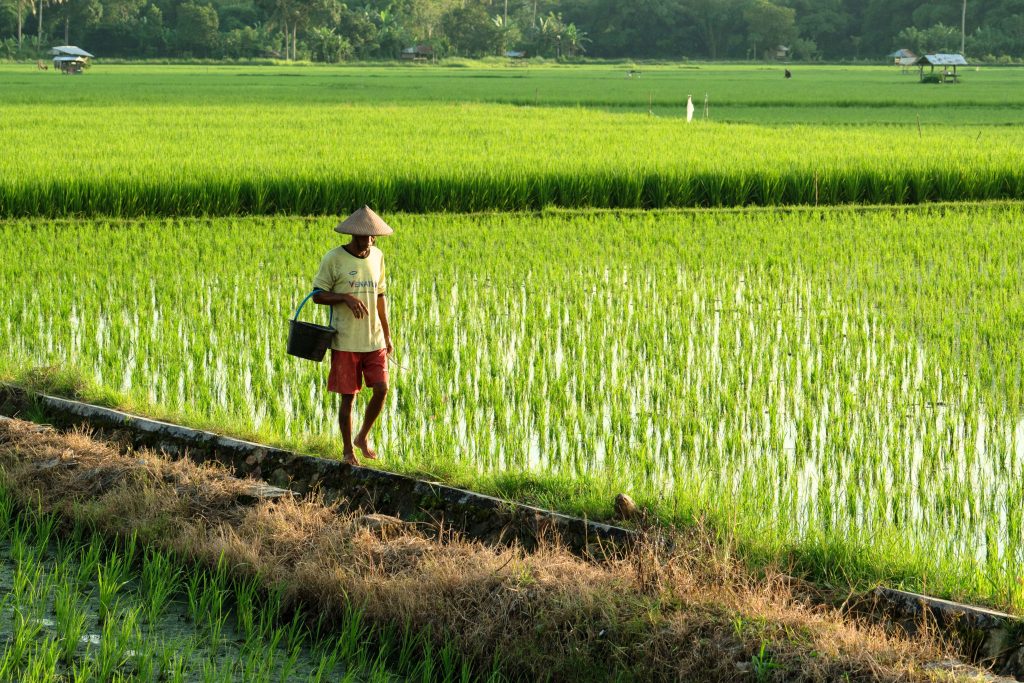
    The sort of pointy hat I wear when no one is looking

    But what looks like a picturesque scene must be hard, backbreaking work.  Rice seeds are first grown in small nursery plots.  After a few weeks, the seedlings are transplanted in the main paddies.  And finally when the rice matures, the paddy is drained and the rice is harvested.  None of this sounds easy.  So the next time you eat a bowl of rice, spare a thought for the people who helped put it on your plate.

    Since I’ve mentioned Indonesia and Spain in my post today, I had a choice of recipe locations.  I’ve gone for a “Spanish Rice” recipe adapted from a recipe my mum-in-law taught me.  Unlike how we usually eat rice, this is not an accompaniment – it’s the main meal, perfect for a weekday lunch.  It’s almost like a Spanish risotto.  I had it today. It may not be completely authentic, but it sure is yummy!
  • The Origin of Rice

    Okay, so perhaps The Origin of Rice isn’t as grand a topic as The Origin of Species, but one that begs to be talked about just the same.  I take it you’re here because you have some sort of feelings towards rice.  So aren’t you just a little curious about how it all began? 

    Well, like many things in this world, it started quite by accident, all of some eight or nine thousand years ago in what we now believe was the Yangtze delta.  People are willing to argue about all sorts aren’t they?  So the archaeologists are in two camps about this.  Most say it started in the Yangtze delta.  But there’s a smaller camp that recently argued that it all started in India.  I’m a democratic sort of soul, so I’ll go with the majority.

    Nobody really knows exactly how it came to be consumed, but some poor, hungry prehistoric hunter-gatherer must have tried eating it after watching birds picking at it and finding that they seemed alive and well after feeding off it. 

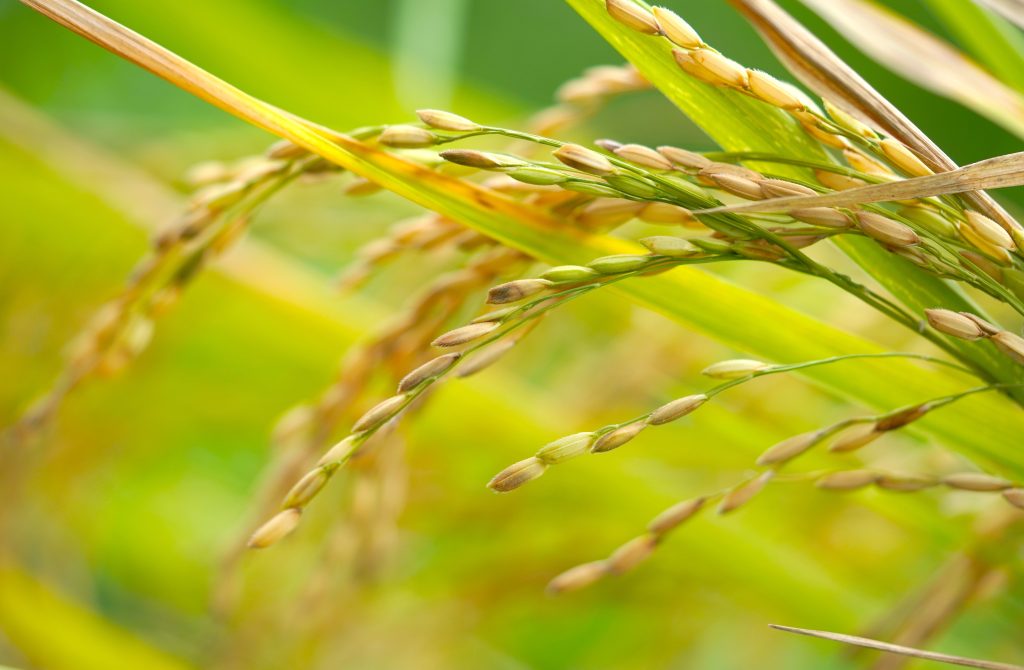
    Isn’t the rice plant beautiful?

    So how did this hungry hunter-gatherer eat it? He wouldn’t have gone straight to making biryani or risotto – of course not.  Like any new discovery, the first iterations of eating rice would have been full of little troubles – bad taste, difficult to digest, hard to chew.  But if it was a matter of survival, and he was truly hungry, he would have persisted, and found that roasting it or boiling it made it more palatable.  Husking it would have made it even better. 

    And at some point, humans as a whole would have twigged that this strange, hard grain, wrapped in an annoyingly hard husk is a reliable source of energy.  The concept of yumminess just wasn’t there in those days.  After all, they weren’t sitting in the comfort of their own home, typing on their laptop while they waited for an egg to boil.

    What happened next is what makes all the difference to the story of rice.  Having found that rice was a good thing, the hunter gatherer started looking for these plants more actively, and started collecting them.  Eventually he cultivated the best of the wild plants that he found, leading to full-blown domestication. Gosh! Imagine how exhausting all this must have been.  If I do an hour’s gardening I think I deserve a treat – perhaps a Reese’s peanut butter cup.  But I’m sure you’ve guessed that all these things weren’t done by the same hungry hunter gatherer that I mentioned a few paragraphs ago.  This entire process took thousands of years. 

    So, there we have it, the origins of rice in a spoonful.  Now I’m curious about why it started in China.  Was it the weather?  Was it just luck?  Or was it just tasted there for the first time, while people in other parts of the world didn’t think to try and eat it?  Let’s find out, shall we?

    As it turns out, this was more by luck than anything else.  An article I read called it the Ecological Jackpot – perfect climatic conditions following the end of the most recent Ice Age, about 10000 years ago, along with a generous monsoon in the Yangtze basin.  This meant that the maximum variety of rice grew quite naturally here.  This is where the highest natural diversity of Oryza rufipogon, the wild ancestor of cultivated rice, was found. 

    Ooooh! I wonder if the word orzo, which is that little Italian pasta that looks like rice has anything to do with the word Oryza. Let me check.  Oh! No it doesn’t.  How disappointing.  Apparently orzo is the Italian word for barley, and the pasta is called that because it resembles barley.  It does not! I know what barley looks like; I have some sitting in my larder. And orzo looks much more like rice than like barley.  Anyway – wild goose chase, and a bit of a tangent.  Back to business.

    So the Ecological Jackpot was the lucky bit.  From here, it turns out that the Chinese were natural boilers because they had the technology – ceramic pots and fire to enable boiling.  At this time, other cultures were still crushing and roasting. 

    The Chinese had also started settling down in small communities, eating acorns, fish and water chestnuts among other things.  When they started running low on these natural items, they didn’t want to break up their communities, and turned to rice to provide them with a solution. 

    And so, to this day, the Chinese remain one of the great rice-eating cultures of the world.  Given that this post has had China so much at the heart of it, this week’s rice bowl recipe is Chinese style egg fried rice with bacon.  I don’t drink much, but I’ve been told it’s a fabulous hangover cure.  I love it just because it tastes so good.