Okay, so perhaps The Origin of Rice isn’t as grand a topic as The Origin of Species, but one that begs to be talked about just the same. I take it you’re here because you have some sort of feelings towards rice. So aren’t you just a little curious about how it all began?
Well, like many things in this world, it started quite by accident, all of some eight or nine thousand years ago in what we now believe was the Yangtze delta. People are willing to argue about all sorts aren’t they? So the archaeologists are in two camps about this. Most say it started in the Yangtze delta. But there’s a smaller camp that recently argued that it all started in India. I’m a democratic sort of soul, so I’ll go with the majority.
Nobody really knows exactly how it came to be consumed, but some poor, hungry prehistoric hunter-gatherer must have tried eating it after watching birds picking at it and finding that they seemed alive and well after feeding off it.
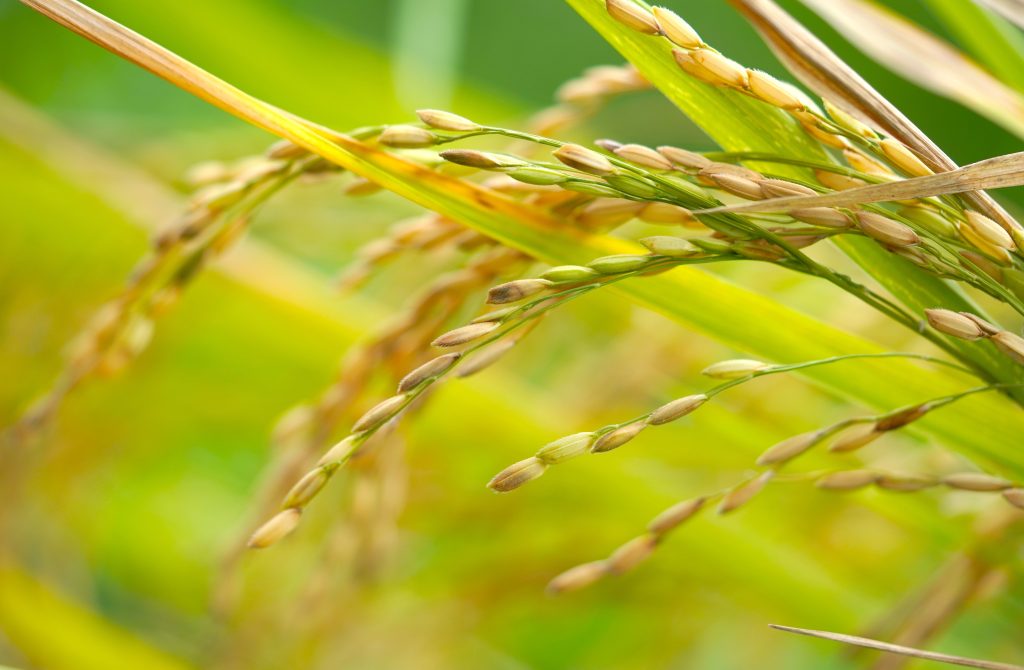
So how did this hungry hunter-gatherer eat it? He wouldn’t have gone straight to making biryani or risotto – of course not. Like any new discovery, the first iterations of eating rice would have been full of little troubles – bad taste, difficult to digest, hard to chew. But if it was a matter of survival, and he was truly hungry, he would have persisted, and found that roasting it or boiling it made it more palatable. Husking it would have made it even better.
And at some point, humans as a whole would have twigged that this strange, hard grain, wrapped in an annoyingly hard husk is a reliable source of energy. The concept of yumminess just wasn’t there in those days. After all, they weren’t sitting in the comfort of their own home, typing on their laptop while they waited for an egg to boil.
What happened next is what makes all the difference to the story of rice. Having found that rice was a good thing, the hunter gatherer started looking for these plants more actively, and started collecting them. Eventually he cultivated the best of the wild plants that he found, leading to full-blown domestication. Gosh! Imagine how exhausting all this must have been. If I do an hour’s gardening I think I deserve a treat – perhaps a Reese’s peanut butter cup. But I’m sure you’ve guessed that all these things weren’t done by the same hungry hunter gatherer that I mentioned a few paragraphs ago. This entire process took thousands of years.
So, there we have it, the origins of rice in a spoonful. Now I’m curious about why it started in China. Was it the weather? Was it just luck? Or was it just tasted there for the first time, while people in other parts of the world didn’t think to try and eat it? Let’s find out, shall we?
As it turns out, this was more by luck than anything else. An article I read called it the Ecological Jackpot – perfect climatic conditions following the end of the most recent Ice Age, about 10000 years ago, along with a generous monsoon in the Yangtze basin. This meant that the maximum variety of rice grew quite naturally here. This is where the highest natural diversity of Oryza rufipogon, the wild ancestor of cultivated rice, was found.
Ooooh! I wonder if the word orzo, which is that little Italian pasta that looks like rice has anything to do with the word Oryza. Let me check. Oh! No it doesn’t. How disappointing. Apparently orzo is the Italian word for barley, and the pasta is called that because it resembles barley. It does not! I know what barley looks like; I have some sitting in my larder. And orzo looks much more like rice than like barley. Anyway – wild goose chase, and a bit of a tangent. Back to business.
So the Ecological Jackpot was the lucky bit. From here, it turns out that the Chinese were natural boilers because they had the technology – ceramic pots and fire to enable boiling. At this time, other cultures were still crushing and roasting.
The Chinese had also started settling down in small communities, eating acorns, fish and water chestnuts among other things. When they started running low on these natural items, they didn’t want to break up their communities, and turned to rice to provide them with a solution.
And so, to this day, the Chinese remain one of the great rice-eating cultures of the world. Given that this post has had China so much at the heart of it, this week’s rice bowl recipe is Chinese style egg fried rice with bacon. I don’t drink much, but I’ve been told it’s a fabulous hangover cure. I love it just because it tastes so good.
Leave a Reply